The User Interface
This page describes the interface elements you’ll encounter across the app.
Table of contents
- The Badge
- The Top Bar
- The Home Navigation Bar
- The Meeting Navigation Bar
- In-Room Banners
- The Motion Drawer
- The Join-Device Dialog
- Recent Debates and Scores
The Badge
Each debate participant is represented by a Badge, which shows the participant’s username, role, and live video. The username and role appear at the top of the badge once the participant has joined; the video, if enabled, fills the centre.
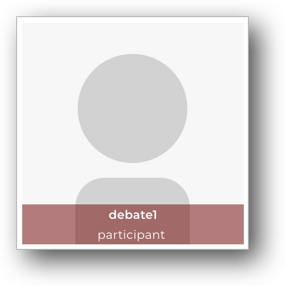
The badge label for the Organizer is red; labels for other participants are gray. During the Debate stage, the current speaker’s badge is highlighted in blue.
Adjudicator badges carry a seat tag after the name: (C) chair, (W) wing, (T) trainee, (S) shadow.
A badge that has been empty for a few seconds — the participant lost their connection, closed the browser, or stepped away — dims and its label gains a · away suffix. The seat itself is kept: the role stays assigned and the badge returns to normal the moment they come back.
An AI adjudicator occupies its seat like any other participant, but shows a distinctive avatar image instead of video.
Red crossed-out microphone or camera icons in the top-right corner mean an adjudicator has force-muted that participant — see Managing Audio and Video.
The Top Bar
The bar across the top of every page holds the debate.club logo and the site menu. On the right:

| Element | Action |
|---|---|
| Login | Shown when you are signed out. Opens the Login dialog. |
| Bell icon | Shown when you are signed in. Opens your notifications. A badge on the bell counts unread items. |
| Person icon | Shown when you are signed in. Opens your profile, where you manage your consents, review reports, and sign out. |
The Home Navigation Bar
When you are signed in, a navigation bar is fixed to the bottom of every page outside of a debate.
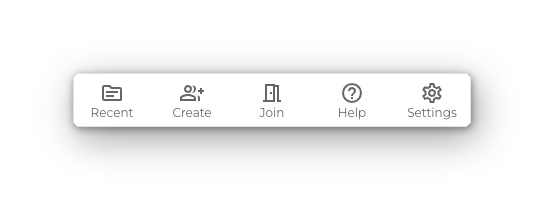
| Button | Action |
|---|---|
| Recent Debates | Return to the home page, which lists your recent debates and any Open Debates currently accepting sign-ups. |
| New Debate | Open the Create Debate dialog. See Create or Join a Debate. |
| Join a Debate | Open the Join Debate dialog. See Create or Join a Debate. |
The Meeting Navigation Bar
Inside a meeting room (Lobby, Preparation, Debate, Evaluation, Adjudicator Room) the navigation bar at the bottom of the screen shows controls that apply to your current stage and role:
| Button | Available in | Purpose |
|---|---|---|
| Start / Stop (camera icon) | All rooms | Turn your camera on or off. |
| Mute / Unmute (microphone icon) | All rooms | Turn your microphone on or off. |
| Debate (motion icon) | All meeting rooms | Open the Motion Drawer. |
| Ask Help | Team members, during Preparation | Toggle the help-needed indicator visible to adjudicators. |
| Done | Team members, during Preparation | Toggle the team-ready indicator visible to adjudicators. |
| Swap Roles | Debaters, during Preparation | Swap your role with your teammate (e.g. Prime Minister and Deputy Prime Minister). |
| I’m done | The current speaker, during Debate, when an AI adjudicator chairs | End your own speech. See Speaking. |
| Ballot | Adjudicators, during Evaluation | Open the Ballot drawer. |
| Discuss | Adjudicators, during Evaluation | Move to the private Adjudicator Room. |
| Return | Adjudicators, when inside a team or adjudicator room | Return to the main room for the current stage. |
| Next stage (arrow) | Adjudicators | Advance to the next stage (Preparation → Debate → Evaluation). Evaluation is the last stage, so no arrow appears there. |
| Leave | All rooms | Leave the debate and return to the home page. The debate continues without you. |
| End debate | Adjudicators, every stage | Terminate the debate for everyone. Asks for confirmation first. |
The set of buttons changes with the stage and your role, so this bar is the single source of truth for what you can do right now. On narrow screens the bar becomes horizontally scrollable; small chevrons at either edge indicate that more buttons are available off-screen.
These buttons control your own microphone and camera. To pause another participant for yourself, or — as an adjudicator — to mute or force-mute someone, see Managing Audio and Video.
Ending a Debate
End debate is the only way to terminate a debate early, and it is available to adjudicators at every stage. It asks for confirmation first:
End this debate? This will immediately terminate the debate for everyone and close all rooms. It cannot be undone.
Everyone else in the debate sees a short notice and is returned to the home page.
In-Room Banners
Above the navigation bar, the Debate Room stacks short notices as they become relevant:
| Banner | Meaning |
|---|---|
| Waiting for the {role} to begin their speech | The floor has moved to that speaker and they haven’t started yet. |
| The speech of {role} begins in N seconds | A count-in is running. Adjudicators and the speaker can Cancel it. |
| AI is transcribing this debate | The debate has an AI adjudicator. You can close this notice. |
| … entering the {room} in ~Ns | The stage is about to change. See The Debate Process. |
The Motion Drawer
Clicking the Debate button in the meeting navigation bar opens a side drawer with:
- the motion text
- the current stage (Lobby, Preparation, Debate, Evaluation)
- the unique debate identifier (a ULID such as
01KRVJ61H2PDPDN7B4687R24HC)
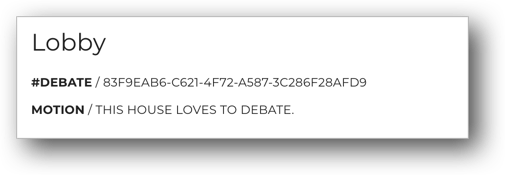
Clicking the identifier copies a join link to your clipboard. Paste the link into email or chat to invite someone to the debate; see Invite Your Team.
Passing the Chair Role
The chair adjudicator can hand the chair role to another adjudicator from this drawer. Open it, pick a wing adjudicator from the reassign menu, and confirm:
{name} will become the chair adjudicator. You will become a wing adjudicator.
The change takes effect immediately for everyone, and a short notice tells the room who took over. Only wing adjudicators who are currently present can be chosen. In a debate where an AI adjudicator holds the chair, the chair role cannot be reassigned.
The Join-Device Dialog
When you enter a meeting room, a dialog asks you to pick your microphone and camera and confirm that you want to publish them. You can also toggle a Blur background effect, turn the microphone or camera off, or pick a different speaker before clicking Join.
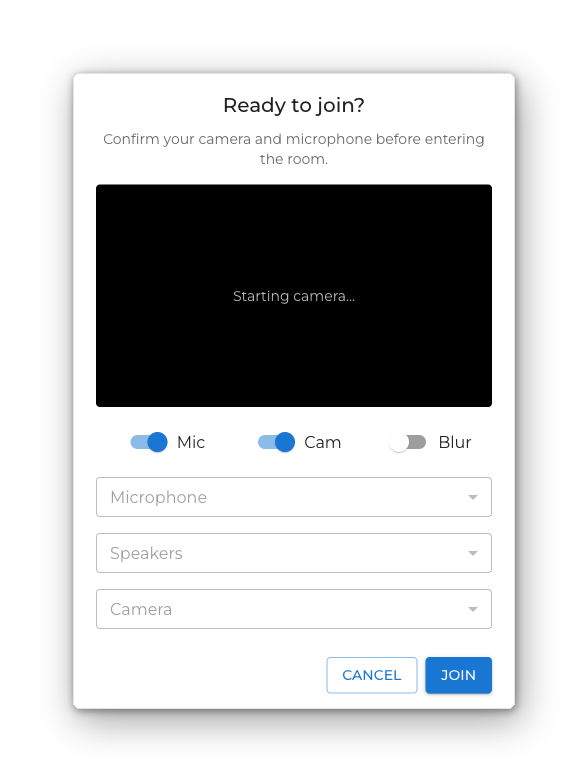
Device and blur choices are remembered for the rest of the session and applied the next time you join a meeting room.
In a debate with an AI adjudicator, the same dialog adds a consent step: your speech will be transcribed and evaluated by AI, so you are asked to agree before joining. Join stays disabled until you tick the box, and the agreement covers that debate only. Grant permanent consent in your profile to stop being asked — see AI Adjudicators.
Recent Debates and Scores
The home page lists debates you have recently taken part in. Each entry shows the motion, the organizer, when the debate took place, the four teams in finishing order with their totals, your score, and — for debates with an AI adjudicator — per-criterion ratings (Evidence, Clarity, Strategy, Engagement).
While a debate is still being evaluated, the card leaves out the finishing order and shows Evaluating · results by 14:30, then refreshes itself when the results arrive.
Once a debate has finished, its card also carries a star rating and a feedback link for telling the debate.club team how the round went — see Rating us on the debate.
A show more chevron expands a card to reveal the full participant list with scores and team ranks, the adjudicator panel, the duration of each stage, and any written feedback you received. See The Ballot.